

Introduction to English Grammar: A Complete Guide for Beginners
Are you trying to speak English but find yourself struggling with the sentences? Do you have plenty of English words but are not sure where to use them or which verb to use? This is a common problem for many English beginners.
How to fix this? Learn English Grammar.
English Grammar is the set of rules which helps us to use, form and arrange words to make meaningful sentences. It helps you to speak correct sentences, effectively express yourself and understand other’s sentences.
Whether you are a student, job seeker, working professional or a spoken English learner, learning the basics of grammar will help you create a strong foundation.
In this beginner’s guide, you will learn what is grammar? Why is it important? Basic rules of English grammar, Sentence structure, How to form positive and negative sentences with practical examples.
1. What Is Grammar? Introduction to English Grammar
Grammar is the set of rules and patterns which helps us to use words in a language. It tells us how to arrange words, how to form sentences, how to use verbs and how to make meaningful sentences.
In simple words, grammar is the way to make meaningful sentences.
For example,
Incorrect: She go to school every day.
Correct: She goes to school every day.
In both the sentences, words are understandable but the second sentence is correct because of the correct subject verb agreement rule.
So, grammar helps you understand why some sentences are correct and some need correction.
Simple Example of Grammar
Let’s see this sentence:
Rahul plays cricket every evening.
Let’s break the sentence:
Rahul: Subject
Plays: Verb
Cricket: Object
Every evening: Time
Each word has its specific role. When you arrange the words according to grammar rules, you get a meaningful sentence.
Grammar is helpful in everyday conversations, email writing, interview preparation, presentation and professional communication.
2. Importance of English Grammar
If you want to build strong speaking and writing skills, it’s important to learn English Grammar. You don’t have to learn all the grammar rules before speaking but learning basic grammar rules helps in communication.
Let’s see why you should learn grammar.
2.1 Helps You Speak Correct English
Grammar helps you arrange words while speaking.
For example,
Incorrect: I am go to office.
Correct: I am going to the office.
By learning the basic structure of sentences, you can express your thoughts more naturally.
2.2 Helps You Improve Your Writing Skills
Whether you are writing an email, application, message or essay, grammar can help you express your thoughts effectively.
For example,
Incorrect: He don’t like coffee.
Correct: He doesn’t like coffee.
By correcting the grammar, your writing will sound more professional.
2.3 Builds Confidence
Many English learners feel hesitant due to the fear of making grammatical mistakes.
By learning the basics of grammar, you can have more confidence to have conversations, ask questions and express your thoughts.
Remember, you can improve your grammar by practicing. You don’t have to be perfect from the start.
2.4 Helps in Interview Preparation
English Grammar is helpful in answering the interview questions.
For example,
Question: Tell me about yourself.
You can say something like this:
“My name is Rahul. I have completed my graduation in commerce. I am interested in learning new skills. I like to work with people.”
By forming sentences correctly, you can effectively present your qualifications and thoughts.
2.5 Helps in Easier Communication
Grammar helps you understand the relationship between words and sentences.
For example,
I completed my work.
I am completing my work.
I will complete my work.
These sentences have different time references. By understanding grammar, you can express them accurately.
3. Basic Rules of English Grammar
Before jumping into advanced grammar, you should learn some basic rules of grammar.
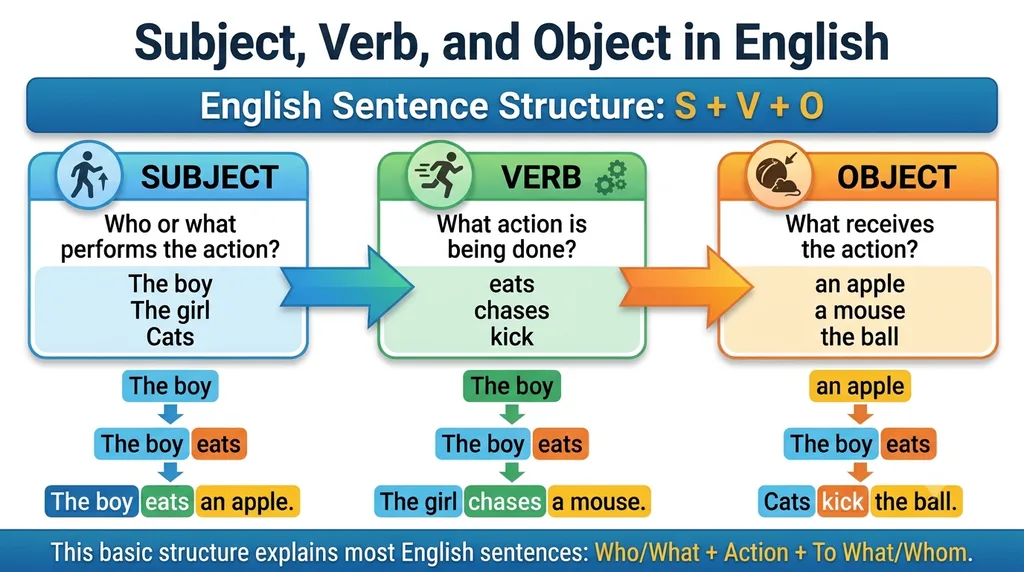
3.1 Every Complete Sentence Must Have a Subject and a Verb
The subject is who or what the sentence is about. Verb is the action or state.
For example,
She smiles.
Rahul works.
They are happy.
Children play.
Imperative sentences (instructions or requests) can have an understood subject.
For example,
“Please sit down.”
Here, the subject “you” is understood.
3.2 Subject Verb Agreement
Verb must agree with the subject in number and person.
For example,
Subject | Correct Verb | Example
I | Am | I am ready.
He | Is | He is happy.
They | Are | They are busy.
She | Plays | She plays tennis.
We | Play | We play tennis.
Some common mistakes:
Incorrect: He go to work.
Correct: He goes to work.
Incorrect: They is students.
Correct: They are students.
3.3 Use the Correct Tense
Tense tells us when something happens.
Generally, we learn 3 main categories of time in English Grammar.
Present Tense: Actions happening now or regularly.
For example, I study English every day.
Past Tense: Actions happening before now.
For example, I studied English yesterday.
Future Tense: Actions expected to happen later.
For example, I will study English tomorrow.
By learning tenses, you can explain your daily activities, past experiences and future plans.
3.4 Use Articles Correctly
We have 3 main articles in English: A, An, The.
A: Before singular countable nouns with consonant sound.
For example, I have a book.
An: Before singular countable nouns with vowel sound.
For example, She is an engineer.
The: When referring to a specific or identifiable person or thing.
For example, The book on the table is mine.
Remember, the choice between “a” and “an” depends on the pronunciation, not just spelling.
3.5 Use Prepositions Correctly
Prepositions help us show relationships like place, time, direction and connections.
Some common prepositions are:
Preposition | Example
In | I live in India.
On | The book is on the table.
At | I am at home.
Under | The bag is under the chair.
Between | She is sitting between two friends.
With | I am going with my brother.
You should learn prepositions in complete sentences because often their correct usage depends on the context.
3.6 Use Pronouns to Avoid Repetition
Pronouns replace nouns and make sentences smoother.
For example,
Without pronoun: Rahul is my friend. Rahul is a teacher. Rahul lives in Delhi.
With pronouns: Rahul is my friend. He is a teacher. He lives in Delhi.
Some common pronouns are I, we, you, he, she, it, they, me, him, her, them.
3.7 Use Correct Punctuation and Capitalisation
Punctuation makes your writing easier to understand.
Some important punctuation marks:
Full stop (.): Ends a statement.
Comma (,): Separates items or parts of a sentence.
Question mark (?): Ends a direct question.
Exclamation mark (!): Expresses strong emotion.
Apostrophe (‘): Shows possession or contractions.
Capital letters are generally used at the beginning of a sentence and for proper nouns.
For example,
Incorrect: my name is rahul.
Correct: My name is Rahul.
4. English Sentence Structure
Sentence structure is the way we arrange words to convey a complete idea.
Generally, in English, we follow the Subject-Verb-Object (SVO) pattern.
Subject + Verb + Object = Sentence
For example,
Riya + reads + books.
Here,
Subject: Riya
Verb: Reads
Object: Books
But not every English sentence needs an object.
For example,
Birds fly.
Children laugh.
He sleeps.
These are complete sentences without an object.
Common English Sentence Patterns
Structure | Example
Subject + Verb | Birds fly.
Subject + Verb + Object | She reads books.
Subject + Verb + Complement | He is intelligent.
Subject + Verb + Indirect Object + Direct Object | She gave me a gift.
By understanding these patterns, you can form different types of sentences.
5. Subject, Verb and Object
Subject, verb and object are important components of many English sentences.
Let’s understand them separately.
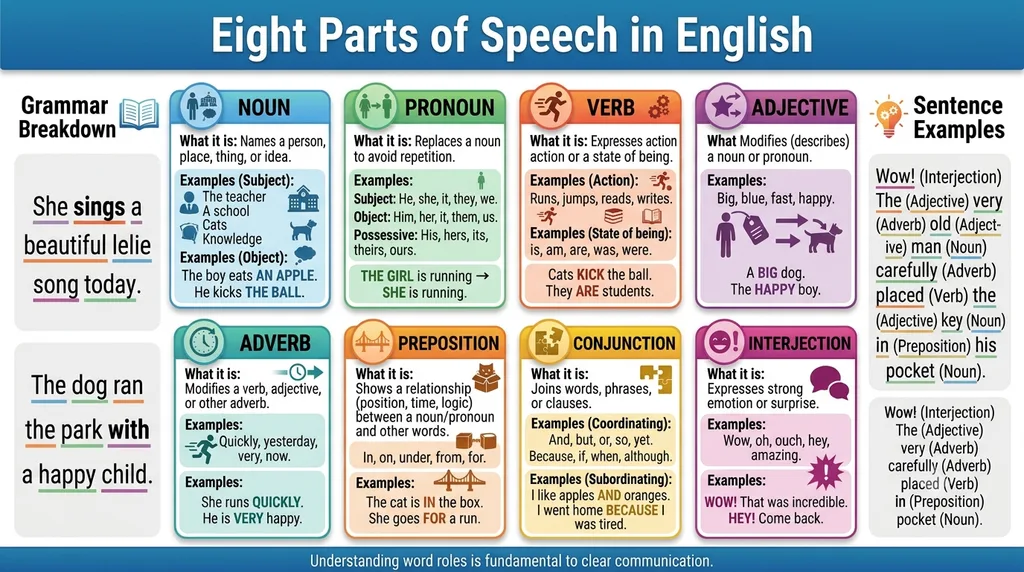
5.1 Subject
Subject is who or what performs the action or what the sentence is about.
For example,
Rahul plays football.
My mother cooks dinner.
Children are playing.
The bold words are the subject.
5.2 Verb
Verb is an action, occurrence or state.
For example,
She writes a letter.
They play cricket.
I am happy.
He is sleeping.
Some common verbs are eat, drink, write, read, speak, work, study, go, come, learn.
5.3 Object
Object is the one receiving or affected by the action of the verb.
For example,
She reads a book.
Rahul plays cricket.
I bought a mobile phone.
The bold words are the object.
Practical Example
Let’s see this sentence:
The teacher explains the lesson.
Subject: The teacher
Verb: Explains
Object: The lesson
You can practice identifying these 3 components in your daily conversations.
6. Basic Sentence Formation
Now that you know the main components of a sentence, let’s learn how to form basic sentences in English.
Start with short and clear sentences. You can make them longer as you understand more.
Step 1: Choose a Subject
First, decide who or what you want to talk about.
For example,
I
You
He
She
We
They
Rahul
Step 2: Choose a Suitable Verb
Choose an action or state that describes the subject.
For example,
Eat
Read
Write
Play
Work
Study
Step 3: Add Object (If Needed)
Add the person or thing affected by the action.
For example,
I read books.
She writes letters.
They play cricket.
Step 4: Add More Information
You can add more details like time, place, manner or frequency.
For example,
I read books every morning.
She writes letters at home.
They play cricket in the evening.
Practice: Form Your Own Sentences
Try forming sentences using the following words:
Subject | Verb | Object
I | Drink | Water
She | Reads | Books
He | Plays | Football
We | Learn | English
They | Watch | Movies
Try forming 5 more sentences with different subjects and verbs.
7. Positive Sentences
Positive sentences, also known as affirmative sentences, express statements or ideas without being negative.
They tell us that something is happening, exists or is true.
For example,
I am a student.
She speaks English.
They play football.
Rahul works in a company.
We are learning grammar.
Structure of Positive Sentences
Common affirmative sentence structure:
Subject + Verb + Object
For example,
I eat an apple.
She teaches English.
They watch television.
For sentences with forms of “to be” verb:
Subject + Am/Is/Are + Complement
For example,
I am happy.
He is intelligent.
They are students.
More Examples of Positive Sentences
Sentence | Hindi Meaning
I am ready. | मैं तैयार हूँ।
She is my sister. | वह मेरी बहन है।
He plays cricket. | वह क्रिकेट खेलता है।
We speak English. | हम अंग्रेजी बोलते हैं।
They are working. | वे काम कर रहे हैं।
Try speaking these sentences. You can change subjects and verbs to create new examples.
8. Negative Sentences
Negative sentences express denial, disagreement or the absence of an action or situation.
In English, we commonly use “not” to make sentences negative.
For example,
I am not busy.
She does not like tea.
He is not sleeping.
They do not play cricket.
Structure of Negative Sentences
The structure depends on the verb type.
A. With Am, Is and Are
Structure:
Subject + Am/Is/Are + Not + Complement
For example,
I am not tired.
He is not a doctor.
They are not ready.
B. With Do and Does
We use do not or does not with the base form of the main verb.
For example,
I do not like coffee.
She does not play tennis.
They do not speak French.
Remember,
Incorrect: She does not likes coffee.
Correct: She does not like coffee.
C. With Did
We use did not followed by the base form of the verb.
For example,
I did not attend the meeting.
He did not call me.
They did not complete their homework.
Incorrect: He did not went there.
Correct: He did not go there.
Positive and Negative Sentences Examples
Positive Sentence | Negative Sentence
I am happy. | I am not happy.
She likes tea. | She does not like tea.
He plays football. | He does not play football.
They are ready. | They are not ready.
We watched a movie. | We did not watch a movie.
By practicing both forms, you can respond naturally in daily conversations.
9. Common Grammar Mistakes to Avoid as a Beginner
There are some common grammatical mistakes that many English learners make. Identifying them can help you improve faster.
Incorrect Sentence | Correct Sentence
He go to school. | He goes to school.
I am agree. | I agree.
She don’t know. | She doesn’t know.
I have a one book. | I have one book.
They was playing. | They were playing.
He is senior than me. | He is senior to me.
I did not went. | I did not go.
She is more taller. | She is taller.
How can you avoid these mistakes?
Read simple English sentences every day.
Notice how verbs change with different subjects.
Learn the rules of grammar with examples.
Write 5-10 sentences daily.
Read your sentences aloud and correct mistakes.
Revise previously learned grammar topics regularly.
Don’t be discouraged when you make mistakes. They can help you identify which grammar rules you need to practice.
10. How to Improve Your English Grammar
You can improve your grammar with a simple and consistent learning routine. You don’t have to study for hours every day.
Try the following things.
10.1 Learn One Grammar Topic at a Time
Don’t study too many grammar rules at once.
Start with nouns, pronouns, verbs, adjectives and adverbs. Once you understand these topics, move to tenses, articles, prepositions and sentence structures.
10.2 Read English Every Day
Read short stories, simple articles, newspapers and educational content.
While reading, notice the sentence formation and how different words are used.
10.3 Practise Writing
Write 5 sentences about your daily routine.
For example,
I wake up at 6 AM.
I brush my teeth.
I take a bath.
I have breakfast.
I go to work.
Check your sentences for spelling, verb forms and sentence structure.
10.4 Speak with Correct Sentence Patterns
Use the grammar you learn in everyday conversations.
For example, practice talking about:
Your daily routine
Your family
Your education
Your hobbies
Your future plans
10.5 Revise and Test Yourself
After studying each topic, do some short grammar exercises.
You can also keep a notebook of incorrect sentences, corrections and new examples.
A practical daily routine of 20 minutes could be like this:
Activity | Time
Learn one grammar rule | 5 minutes
Read English sentences | 5 minutes
Write 5 practice sentences | 5 minutes
Speak the sentences aloud | 5 minutes
Total | 20 minutes
The idea is to use grammar in real communication, not just memorise rules without applying them.
11. Frequently Asked Questions (FAQs)
1. What is English grammar in simple words?
English grammar is a set of rules which helps us to use and arrange words to make meaningful sentences. It helps you speak and write English correctly.
2. How can a beginner start learning English grammar?
Start with basic topics like nouns, pronouns, verbs, adjectives and adverbs. Then learn sentence formation, articles, prepositions, tenses and subject-verb agreement.
3. What are the basic rules of English grammar?
Some important basic rules are using the correct subject-verb agreement, using the correct verb tenses, arranging words correctly, using articles and prepositions correctly and following punctuation rules.
4. Can I speak English without learning grammar?
Yes, you can start speaking English using simple expressions and commonly used sentences. But learning the basics of grammar helps you form clearer and more accurate sentences.
5. How long does it take to learn basic English grammar?
The time depends on your starting level, learning routine and practice. You can start understanding the basic concepts of grammar in a few weeks if you study regularly. But accuracy takes more practice.
6. Which grammar topic should I learn first?
Start with parts of speech, especially nouns, pronouns and verbs. Then move to basic sentence structures and simple tenses.
7. How can I practice English grammar at home?
Read English books, write daily sentences, watch educational lessons, do grammar exercises and speak aloud using the learned rules.
8. Is grammar important for spoken English?
Yes, grammar helps you organise your thoughts and express them clearly. But you should practice speaking along with grammar lessons, not wait to master every rule.
12. Conclusion
English grammar is the foundation for improving your speaking, reading and writing skills. By understanding how words work together, you can form meaningful sentences and convey your thoughts more effectively.
Start with simple concepts like parts of speech, subject-verb agreement, sentence structure and basic tenses. Practice positive and negative sentences, identify mistakes and use new grammar rules in daily conversations.
You don’t need to learn everything in one day. Focus on one topic at a time and apply what you learn.
Start your grammar journey today! Explore more practical lessons on English grammar, spoken English, vocabulary, pronunciation and effective communication at Fluent Personality.
Think Better | Speak Better | Become Better.