Pronoun in English Grammar: Meaning, Types, Rules, Examples
Learn about different types of pronouns, their usage, essential grammar rules and common mistakes in using pronouns. Practice with lots of examples in everyday English conversations to improve your grammar and speaking skills.
1. What Is a Pronoun?
A pronoun is a word that can be used in place of a noun.
सर्वनाम (Sarvanam) in Hindi.
Examples:
Priya is a teacher. She teaches English.
Amit is my friend. He lives in Mumbai.
The children are playing. They are happy.
This is my phone. It is expensive.
These words, she, he, they, it are used instead of words like Priya, Amit, children, phone.
Simple formula:
Noun + Pronoun = Clear and natural sentences
2. Importance of Pronouns in English
Pronouns are very important in both spoken and written English.
Why do we use pronouns?
1. To avoid repetition
We can use He is intelligent instead of Rohit is intelligent.
2. To make communication better
Pronouns help us to make the conversation short and easy to understand.
3. To make sentences natural
Native and fluent English speakers use pronouns a lot in everyday conversations.
4. To make sentence formation better
By understanding pronouns, you can form grammatically correct sentences.
5. To make communication smoother
Pronouns are useful in many situations such as meetings, interviews and public speaking. They help to make the communication smooth without being repetitive.
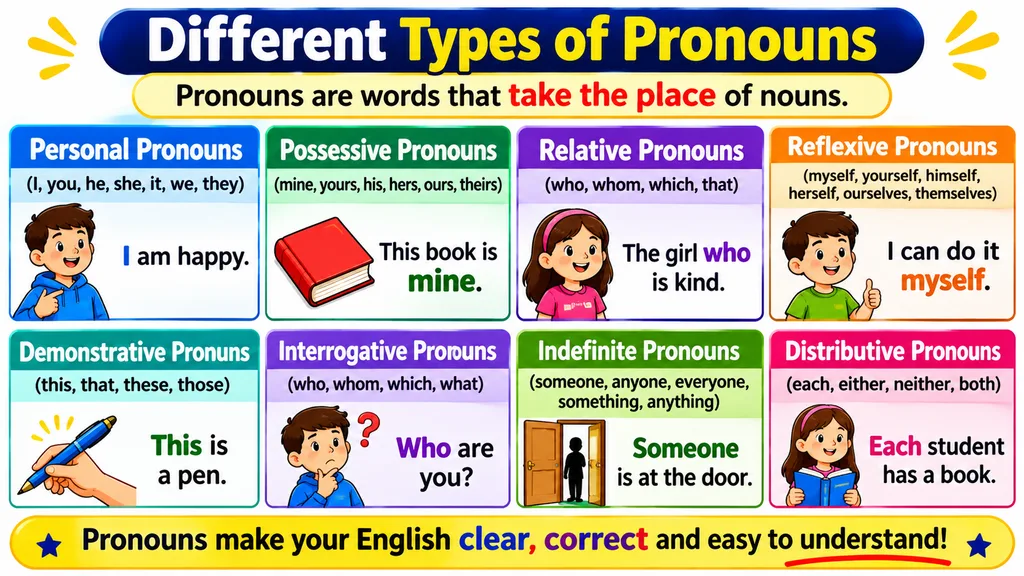
3. Types of Pronouns in English Grammar
There are several types of pronouns in English grammar.
3.1 Personal Pronouns
These pronouns refer to people, animals and things.
Personal pronouns are generally divided into three persons:
First person: The person speaking
Second person: The person being spoken to
Third person: The person or thing being spoken about
Personal Pronoun Table
| Person | Subject Pronoun | Object Pronoun |
|---|---|---|
| First Person Singular | I | Me |
| First Person Plural | We | Us |
| Second Person | You | You |
| Third Person Masculine | He | Him |
| Third Person Feminine | She | Her |
| Third Person Neutral | It | It |
| Third Person Plural | They | Them |
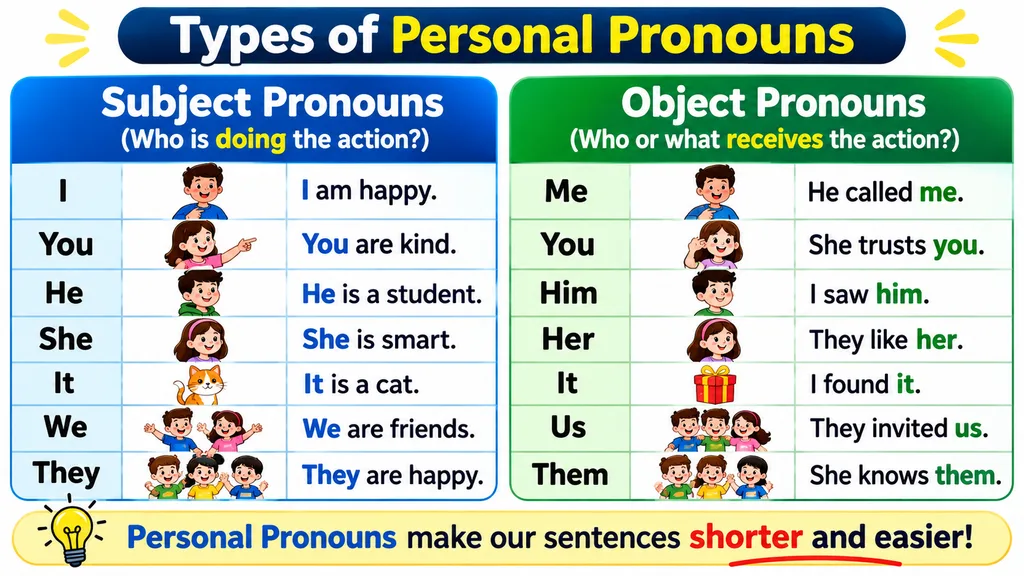
Examples:
I am learning English.
We are going to the office.
You are a good friend.
He is my manager.
She is preparing for an interview.
It is raining outside.
They are playing cricket.
Important difference:
Subject pronouns perform the action. Object pronouns receive the action.
She called me.
I helped him.
They invited us.
Gmail
3.2 Possessive Pronouns
Possessive Pronouns: Words that show possession.
They answer the question: Whose?
Common possessive pronouns:
Mine, yours, his, hers, ours, theirs
Examples:
This book is mine.
That laptop is yours.
The blue car is hers.
This house is ours.
Those bags are theirs.
The decision was his.
Important distinction: Possessive Pronouns vs Possessive Adjectives
| Possessive Determiner | Possessive Pronoun |
|---|---|
| My | Mine |
| Your | Yours |
| His | His |
| Her | Hers |
| Our | Ours |
| Their | Theirs |
Examples:
This is my pen. (Possessive determiner)
This pen is mine. (Possessive pronoun)
Note: Words like my, your, her, their are used before nouns. They are possessive determiners and not separate possessive pronouns.
3.3 Reflexive Pronouns
These pronouns are used when the subject and the object in a sentence refer to the same person or thing.
They generally end with -self or -selves.
| Subject | Reflexive Pronoun |
|---|---|
| I | Myself |
| You (singular) | Yourself |
| He | Himself |
| She | Herself |
| It | Itself |
| We | Ourselves |
| You (plural) | Yourselves |
| They | Themselves |
Examples:
I taught myself English.
She prepared herself for the interview.
He hurt himself while playing.
We enjoyed ourselves at the party.
They introduced themselves.
Reflexive pronouns can be useful when the person who performs the action also receives the action.
3.4 Emphatic/Intensive Pronouns
These pronouns are used to emphasize the person or thing performing the action.
The form of emphatic pronouns is the same as reflexive pronouns, but the purpose is different.
Examples:
I myself completed this project.
The manager himself attended the meeting.
She herself prepared the presentation.
We ourselves organised the event.
Difference between reflexive pronouns and emphatic pronouns:
Reflexive: I hurt myself. (Action affects the subject)
Emphatic: I myself completed the work. (Myself is used for emphasis)
An easy test: If you remove the emphatic pronoun, the basic sentence will still be grammatically complete.
3.5 Demonstrative Pronouns
These pronouns point to specific people, objects, or things.
There are four main demonstrative pronouns:
| Pronoun | Usage | Example |
|---|---|---|
| This | Near, singular | This is my phone. |
| That | Far, singular | That is your car. |
| These | Near, plural | These are my books. |
| Those | Far, plural | Those are beautiful flowers. |
Examples:
This is my favourite book.
That belongs to my brother.
These are very useful.
Those are my colleagues.
Easy way to remember:
This = Near + One
That = Far + One
These = Near + More than one
Those = Far + More than one
3.6 Interrogative Pronouns
Interrogative pronouns are used to ask questions.
The main interrogative pronouns are:
Who, Whom, Whose, Which, What
| Pronoun | Purpose | Example |
|---|---|---|
| Who | To ask about a person as subject | Who called you? |
| Whom | To ask about a person as object | Whom did you meet? |
| Whose | To ask about ownership | Whose bag is this? |
| Which | To ask about a choice | Which is your car? |
| What | To ask about something | What is your name? |
More examples:
Who is your English teacher?
What are you doing?
Which is your favourite subject?
Whose phone is ringing?
Whom did you invite?
In everyday spoken English, people often use who instead of whom. But it’s good to understand the difference grammatically, especially in formal English.
3.7 Relative Pronouns
These pronouns are used to link a dependent clause to a noun or pronoun mentioned before. They give more information about that noun.
The common relative pronouns are Who, Whom, Whose, Which, That.
Examples:
The man who lives next door is a doctor.
The woman whom you met is my sister.
The student whose bag was missing found it.
This is the book which I purchased yesterday.
The movie that we watched was interesting.
Understanding their uses:
Who: Used for people as the subject of the relative clause.
Whom: Used for people as the object.
Whose: Used to show possession.
Which: Generally used for animals or things.
That: Can be used for people, animals, or things in defining relative clauses.
Relative pronouns help us link short sentences to make meaningful, connected sentences.
3.8 Indefinite Pronouns
These pronouns are used to refer to people, things, or quantities in a non-specific way.
Common indefinite pronouns:
Someone, somebody, anyone, anybody, everyone, everybody, nobody, no one, something, anything, everything, nothing, few, many, several, all, some, none.
Examples:
Someone is waiting outside.
Everyone is ready for the meeting.
Nobody knows the answer.
Something is wrong with my computer.
Everything is under control.
Many were invited to the event.
Few understood the question.
Indefinite pronouns can be very useful when the exact person or thing is not known or not important.
3.9 Distributive Pronouns
These pronouns are used to refer to people or things individually instead of collectively.
The commonly used distributive pronouns are Each, Either, Neither.
Examples:
Each of the students received a certificate.
Either of these options is acceptable.
Neither of the answers is correct.
Each of us has a responsibility.
Note: Each, either, neither generally take singular verbs when used as pronouns.
3.10 Reciprocal Pronouns
These pronouns are used to express mutual or shared action between two or more people.
The two reciprocal pronouns are:
Each other
One another
Examples:
Rahul and Amit help each other.
The two friends respect each other.
The team members support one another.
We should listen to one another.
Reciprocal pronouns can be useful when describing relationships, teamwork, cooperation, shared responsibilities, etc.
Gmail
4. Important Rules of Pronouns
It’s not enough to know the types of pronouns. You also need to know how to use them correctly.
Rule 1: A pronoun should agree with its antecedent
The antecedent is the noun the pronoun refers to.
Incorrect: Riya is my friend. He is very helpful.
Correct: Riya is my friend. She is very helpful.
The pronoun should match the antecedent in number and appropriate person reference.
Rule 2: Use subject pronouns as subjects
Incorrect: Me and Rahul are going to the office.
Correct: Rahul and I are going to the office.
Use I, we, he, she, they, you as subjects.
Rule 3: Use object pronouns after verbs and prepositions
Incorrect: The manager called I.
Correct: The manager called me.
Other examples:
She spoke to him.
The teacher helped us.
This gift is for them.
Rule 4: Don’t confuse possessive pronouns with possessive determiners
Incorrect: This book is my.
Correct: This book is mine.
Incorrect: This is mine book.
Correct: This is my book.
Rule 5: Use reflexive pronouns correctly
Incorrect: Myself Girish.
Correct: I am Girish.
Incorrect: Please contact myself.
Correct: Please contact me.
Don’t use reflexive pronouns instead of ordinary subject or object pronouns.
Rule 6: Use demonstrative pronouns according to number
Incorrect: This are my books.
Correct: These are my books.
Incorrect: Those is my car.
Correct: That is my car.
Rule 7: Use singular verbs with indefinite pronouns like everyone, somebody, etc.
Incorrect: Everyone are happy.
Correct: Everyone is happy.
Incorrect: Somebody have called you.
Correct: Somebody has called you.
Rule 8: Use singular or plural pronouns based on the intended meaning
Incorrect: The children are playing because he are happy.
Correct: The children are playing because they are happy.
If you are referring to multiple people, use an appropriate plural pronoun.
5. Pronouns in Everyday English Conversations
Understanding grammar is more useful when you can apply it in real-life situations.
Let’s look at some everyday conversations.
Conversation 1: At the office
Amit: Where is Rahul?
Priya: He is in the meeting room.
Amit: Can you ask him to call me?
Priya: Sure, I will tell him.
Conversation 2: Among friends
Rahul: Is this your laptop?
Amit: No, it is hers.
Rahul: Whose laptop is that?
Amit: It belongs to Neha.
Conversation 3: In an interview
Interviewer: Tell me about yourself.
Candidate: I am an engineering professional. I have experience in project execution and team coordination. I consider myself a responsible and hardworking person.
Notice how natural pronouns sound in these conversations.
Try to identify pronouns in your everyday conversations. You’ll quickly realise how much you use pronouns.
6. Common Pronoun Mistakes and Their Corrections
| Incorrect Sentence | Correct Sentence |
|---|---|
| Me am happy. | I am happy. |
| Her is my friend. | She is my friend. |
| This book is my. | This book is mine. |
| Myself Rahul. | I am Rahul. |
| Everyone are present. | Everyone is present. |
| Him and I are friends. | He and I are friends. |
| They is coming. | They are coming. |
| This are my shoes. | These are my shoes. |
| The teacher helped we. | The teacher helped us. |
| Each of them have a car. | Each of them has a car. |
Useful learning tip: Don’t just memorise the correct sentences. Try to understand why the original sentence was incorrect. This will help you avoid making the same mistake in future conversations.
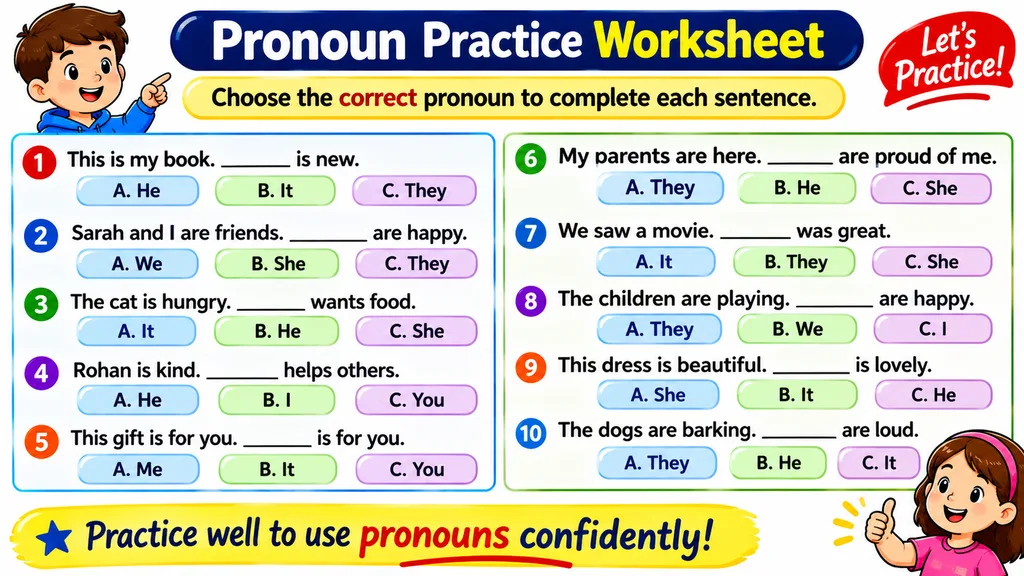
7. Practice Exercises: Test Your Understanding
Now, it’s time to test your understanding.
Exercise 1: Fill in the blanks
Choose the correct pronoun.
Rahul is my brother. _____ is an engineer.
This pen is mine. It is _____.
The children are playing. _____ are happy.
She completed the project by _____.
_____ is your favourite teacher?
_____ books are lying on the table near you?
Everyone _____ invited to the party.
Amit and Rahul help _____.
The woman _____ lives here is a doctor.
The teacher gave _____ a prize.
Exercise 2: Identify the type of pronoun
Identify the pronoun in each sentence.
She is my best friend.
This is my house.
I completed the work myself.
Someone is knocking at the door.
Who is your manager?
The boy who won the competition is my brother.
These are very expensive.
Each of the students received a book.
They respect one another.
This bag is mine.
Exercise 3: Correct the sentences
Rewrite the sentences correctly.
Me is learning English.
She completed the work by hisself.
Everyone are ready.
This are my books.
The manager called I.
This is her’s bag.
Each of the boys have a bicycle.
Myself will attend the meeting.
Answers
Exercise 1:
He
Mine
They
Herself
Who
Which
Is
Each other
Who
Me
Exercise 2:
Personal pronoun
Demonstrative pronoun
Emphatic pronoun
Indefinite pronoun
Interrogative pronoun
Relative pronoun
Demonstrative pronoun
Distributive pronoun
Reciprocal pronoun
Possessive pronoun
Exercise 3:
I am learning English.
She completed the work by herself.
Everyone is ready.
These are my books.
The manager called me.
This is her bag.
Each of the boys has a bicycle.
I will attend the meeting.
8. Frequently Asked Questions About Pronouns
1. What is a pronoun in English grammar?
A pronoun is a word used in place of a noun. Examples: I, you, he, she, it, we, they.
2. How many types of pronouns are there in English?
In traditional English grammar, we often learn about different categories of pronouns like personal pronouns, possessive pronouns, reflexive pronouns, emphatic pronouns, demonstrative pronouns, interrogative pronouns, relative pronouns, indefinite pronouns, distributive pronouns, reciprocal pronouns, etc. Different grammar references may classify pronouns differently.
3. What is the difference between a noun and a pronoun?
A noun is used to name a person, place, animal, thing, etc. A pronoun is used in place of a noun.
Example:
Rahul is intelligent. (Noun)
He is intelligent. (Pronoun)
4. What are the five main personal pronouns?
Five commonly used personal pronouns are I, you, he, she, it. Other personal pronouns include we, they, and their object forms.
5. What is the difference between reflexive pronouns and emphatic pronouns?
Reflexive pronouns are used to refer back to the subject when the subject and object are the same. Emphatic pronouns are used to add emphasis to the subject.
Example:
I taught myself English. (Reflexive pronoun)
I myself completed the task. (Emphatic pronoun)
6. What are demonstrative pronouns?
Demonstrative pronouns are used to point to specific people, things, etc. The four main demonstrative pronouns are this, that, these, those.
7. Can we use ‘they’ for a single person?
Yes. We often use singular ‘they’ when we don’t know the gender of a person or when it’s not relevant. Or when the person uses they/them pronouns.
Example:
Someone left their phone. They might come back for it.
8. How can I improve using pronouns in spoken English?
Practice making simple sentences. Read English conversations. Try to find the pronouns while reading. Use pronouns in your spoken English. Correct your mistakes regularly. This will help you to improve your confidence and accuracy.
9. Conclusion: Make Your English Clearer with Pronouns
Pronouns may seem like small words, but they play an important role in English communication. Pronouns help us avoid repetition, link ideas, and express ourselves naturally.
From personal pronouns like I, you, they to relative pronouns like who, which, that, each type of pronoun has a different purpose.
To master pronouns, you can focus on three things:
Understand the different types of pronouns.
Learn the grammar rules with practical examples.
Use pronouns regularly in your everyday conversations.
Don’t just read grammar rules. Practise speaking, form sentences, correct your mistakes, etc.
At Fluent Personality, we believe better grammar is the foundation for better communication.
Explore more English grammar lessons, vocabulary resources, speaking activities, communication tips, etc. on Fluent Personality.
Think Better. Speak Better. Become Better.