
Noun: Meaning, Types, Rules, and Examples in English Grammar
Have you ever wondered how to find out the names of people, places, animals, and things in a sentence in English grammar? All these words like teacher, school, dog, book, happiness may look different but they have something in common. They are all nouns.
Noun is one of the most important parts of English grammar. It helps us to know the names of people, places, things, or ideas we are talking about. Without nouns, it would be difficult to describe people, talk about places, objects, or express our ideas.
For example:
- Rahul is reading a book.
- My mother works in Delhi.
- The dog is playing in the garden.
- Honesty is a good quality.
In these sentences, Rahul, book, mother, Delhi, dog, garden, and honesty are nouns.
Whether you are learning to speak English, preparing for an interview, or improving your writing skills, knowing about nouns will help you to create better sentences.
In this beginner-friendly guide, you will learn the meaning of nouns, different types of nouns, important grammar rules, examples, and exercises.
1. What Is a Noun?
A noun is a word that names a person, place, animal, thing, idea, feeling, or quality.
In simple words, noun is the name of something.
Let’s understand with some examples.
| Category | Examples |
|---|---|
| Person | Rahul, teacher, doctor, student |
| Place | India, Delhi, school, hospital |
| Animal | Dog, cat, elephant, lion |
| Thing | Book, table, mobile, chair |
| Feeling | Love, happiness, sadness, anger |
| Quality | Honesty, kindness, bravery, patience |
For example:
Sentence: Riya is reading a book in her room.
Here,
- Riya: Name of a person
- Book: Name of a thing
- Room: Name of a place
All three words are nouns.
We use nouns in almost every English conversation. Whether we introduce ourselves, talk about our family, workplace, or our daily activities, we use nouns naturally.
2. Importance of Nouns in English Grammar
Nouns are important because they help us communicate clearly. They give names to the people, places, things, or ideas we are talking about.
Here are some reasons why we need to learn about nouns.
2.1 Helps You Form Meaningful Sentences
Nouns help you to identify the subject or object in a sentence.
For example:
- Rahul plays cricket.
- My sister reads books.
- The teacher explains grammar.
Without nouns, it would be hard to know who is doing something or what they are doing.
2.2 Improves Your Vocabulary
By learning about nouns, you can add new words to your vocabulary that you can use in your daily conversations.
For example, you can learn words related to:
- Family: Father, mother, brother, sister.
- Education: School, classroom, examination, subject.
- Workplace: Office, manager, employee, meeting.
- Travel: Airport, railway station, ticket, luggage.
2.3 Improves Your Writing Skills
Nouns help you to describe people, places, or situations more accurately.
For example:
Without specific nouns: He went there and met him.
With specific nouns: Rahul went to the office and met his manager.
The second sentence is more clear.
2.4 Helps You Understand Other Grammar Topics
Nouns are closely related to other parts of speech such as pronouns, adjectives, verbs, articles, and prepositions.
For example:
The intelligent student completed the assignment.
- Student: Noun
- Intelligent: Adjective
- Completed: Verb
- The: Article
- Assignment: Noun
Understanding nouns helps you to learn about other parts of speech easily.
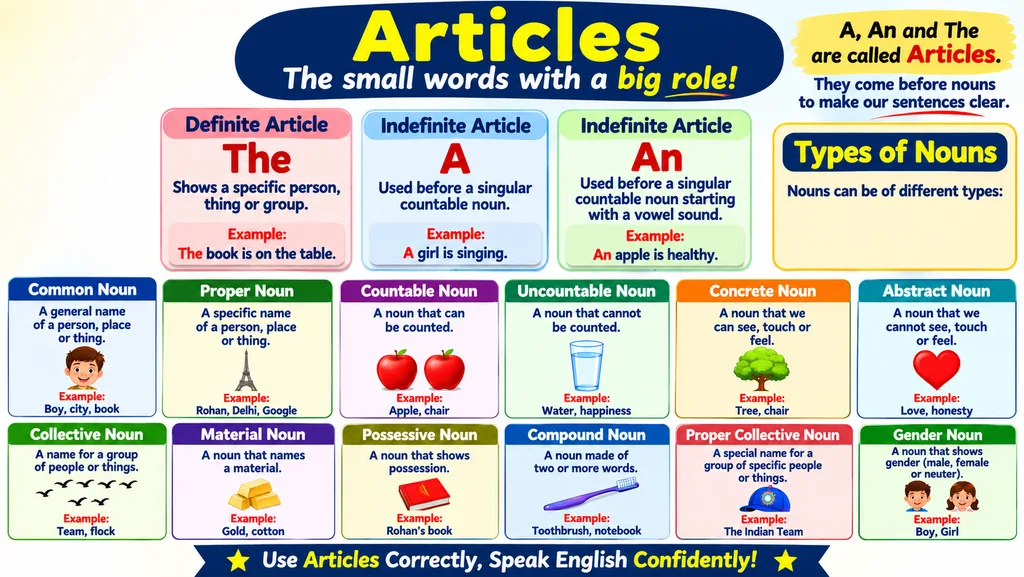
3. Types of Nouns in English Grammar
In English grammar, we usually teach five main types of nouns: Proper nouns, Common nouns, Collective nouns, Material nouns, and Abstract nouns.
We can also classify nouns into concrete nouns and countable/uncountable nouns. These classifications are based on different features of nouns. So, some nouns can fall into multiple categories.
Let’s learn about the main types of nouns with examples.
3.1 Proper Noun
Proper noun is the specific name of a particular person, place, organization, or thing.
Usually, proper nouns start with capital letters.
Examples:
- Rahul
- Priya
- India
- Mumbai
- Monday
- January
- The Taj Mahal
Sentences:
- Rahul lives in Delhi.
- India is a beautiful country.
- My birthday is in January.
- Priya works at Google.
Note: The first letter of each proper noun is capitalized.
Remember: Proper noun is the name of a specific thing, not a general thing.
3.2 Common Noun
Common noun is the general name of a person, place, animal, or thing.
Examples:
- Boy
- Girl
- Teacher
- City
- Country
- School
- River
- Book
Sentences:
- The boy is playing football.
- My teacher is very helpful.
- This city is beautiful.
- I purchased a new book.
Let’s compare proper nouns and common nouns.
| Proper Noun | Common Noun |
|---|---|
| Rahul | Boy |
| India | Country |
| Delhi | City |
| Ganga | River |
| Monday | Day |
| Taj Mahal | Monument |
Proper noun is the specific name. Common noun is the general name.
3.3 Collective Noun
Collective noun refers to a group of people, animals, or things as a whole.
Examples:
- Team
- Family
- Class
- Army
- Committee
- Audience
- Herd
- Flock
- Bunch
Sentences:
- Our team won the match.
- My family lives in Haryana.
- A flock of birds is flying in the sky.
- The teacher welcomed the class.
Some more collective nouns with examples:
| Collective Noun | Group |
|---|---|
| Team | Players |
| Family | Family members |
| Herd | Cattle or other animals |
| Flock | Birds, sheep |
| Bunch | Flowers, grapes |
| Army | Soldiers |
| Audience | People watching a performance |
Sometimes in British English, collective nouns can take singular or plural verbs. It depends on whether you view the group as a single unit or individuals. In American English, the singular agreement is more common.
3.4 Material Noun
Material noun is the name of the substance or material from which something is made.
Examples:
- Gold
- Silver
- Iron
- Wood
- Cotton
- Water
- Milk
- Plastic
Sentences:
- This ring is made of gold.
- The table is made of wood.
- We drink water every day.
- My shirt is made of cotton.
Sometimes material nouns are considered as uncountable nouns.
3.5 Abstract Noun
Abstract noun is the name of an idea, feeling, quality, condition, or experience. You cannot physically touch them.
You can understand or experience them, but you can’t hold them like a book or a mobile phone.
Examples:
- Love
- Honesty
- Happiness
- Freedom
- Childhood
- Courage
- Knowledge
- Friendship
Sentences:
- Honesty is the best policy.
- Happiness makes our lives enjoyable.
- Freedom is important for everyone.
- Her kindness impressed the students.
- Courage helps us to face difficult situations.
Abstract nouns are commonly used when we express our thoughts, emotions, or personal qualities.
3.6 Concrete Noun
Concrete noun is the name of something that you can experience with your physical senses like see, hear, touch, taste, or smell.
Examples:
- Apple
- Chair
- Flower
- Dog
- Music
- Perfume
- Chocolate
Sentences:
- The apple is fresh.
- The dog is barking.
- I bought a new chair.
- The perfume smells pleasant.
Difference between concrete noun and abstract noun:
| Concrete Noun | Abstract Noun |
|---|---|
| Table | Happiness |
| Flower | Beauty |
| Dog | Loyalty |
| Book | Knowledge |
| Child | Childhood |
| Friend | Friendship |
3.7 Compound Noun
Compound noun is formed when two or more words combine to name a person, place, thing, or idea.
Examples:
- Toothbrush
- Football
- Classroom
- Railway station
- Bus stop
- Mother-in-law
- Swimming pool
Compound nouns can be written as a single word, separate words, or with a hyphen.
Sentences:
- I forgot my toothbrush.
- The students are sitting in the classroom.
- We are waiting at the bus stop.
- My mother-in-law lives in Jaipur.
4. Countable and Uncountable Nouns
Another important way to classify nouns is whether they are countable or not.
4.1 Countable Nouns
Countable nouns are those nouns that can be counted individually.
Examples:
- One book, two books
- One apple, three apples
- One student, five students
- One chair, four chairs
We can use numbers and a/an with singular countable nouns.
For example:
- I have a pen.
- She bought three dresses.
- There are five students in the classroom.
4.2 Uncountable Nouns
Uncountable nouns are those nouns that are usually not counted as individual separate units.
Examples:
- Water
- Rice
- Milk
- Information
- Advice
- Furniture
- Knowledge
- Luggage
Sentences:
- I need some water.
- She gave me some useful advice.
- We bought new furniture.
- He has a lot of knowledge.
Generally, we don’t use a/an or the usual plural forms with these nouns.
Incorrect: I need an advice.
Correct: I need some advice.
You can measure some uncountable nouns by using expressions like:
- A glass of water
- A cup of tea
- A piece of advice
- A piece of information
- A bag of rice
It is important to know the difference between countable and uncountable nouns. This helps in choosing the articles, quantity words like much, many, some, any, etc.
5. Singular and Plural Nouns
Nouns can be singular or plural.
5.1 Singular Nouns
Singular noun refers to one person, animal, place, or thing.
Examples:
- Boy
- Girl
- Book
- Car
- Teacher
- Student
Sentences:
- The boy is playing.
- She has a book.
- My teacher is helpful.
5.2 Plural Nouns
Plural noun refers to more than one person, animal, place, or thing.
Examples:
- Boys
- Girls
- Books
- Cars
- Teachers
- Students
Sentences:
- The boys are playing.
- She has two books.
- The teachers are helpful.
6. Rules for Forming Plural Nouns
Most plural nouns are formed by simple spelling patterns. But some nouns have irregular plural forms.
| Rule | Singular | Plural |
|---|---|---|
| Add -s | Book | Books |
| Add -es | Box | Boxes |
| Add -ies | City | Cities |
| Add -ves | Knife | Knives |
| Irregular form | Child | Children |
| Irregular form | Man | Men |
| Irregular form | Foot | Feet |
| Same form | Sheep | Sheep |
Important Plural Rules
Rule 1: Add -s
Most nouns form their plural by adding -s.
- Pen → Pens
- Chair → Chairs
- Table → Tables
Rule 2: Add -es
Nouns ending with sounds/spellings like -s, -ss, -sh, -ch, -x, etc. usually take -es.
- Bus → Buses
- Class → Classes
- Dish → Dishes
- Watch → Watches
- Box → Boxes
Rule 3: Change -y to -ies
If a noun ends with a consonant + -y, change -y to -ies.
- Baby → Babies
- City → Cities
- Lady → Ladies
If the noun ends with a vowel + -y, just add -s.
- Boy → Boys
- Toy → Toys
- Day → Days
Rule 4: Change -f/-fe to -ves in some nouns
Some nouns follow this rule.
- Leaf → Leaves
- Wife → Wives
- Knife → Knives
But not all nouns ending with -f/-fe follow this rule.
For example:
- Roof → Roofs
- Chief → Chiefs
Rule 5: Learn irregular plural forms
Some nouns change completely in plural form.
- Man → Men
- Woman → Women
- Child → Children
- Tooth → Teeth
- Foot → Feet
- Person → People
By practicing regularly, you can learn these forms and avoid common mistakes.
7. Functions of Nouns in Sentences
Nouns have different functions in English sentences. Knowing these functions helps you to identify the role of the noun.
7.1 Noun as a Subject
Subject is the person or thing that does the action or the sentence is about.
Examples:
- Rahul plays cricket.
- The baby is sleeping.
- My father works in an office.
Here, Rahul, baby, and father are subjects.
7.2 Noun as an Object
Object is the person or thing that receives the action or is affected by the verb.
Examples:
- She reads a book.
- Rahul kicked the ball.
- My mother prepared dinner.
Here, book, ball, and dinner are objects.
7.3 Noun as Subject Complement
Noun can identify or describe the subject after a linking verb.
Examples:
- Rahul is a doctor.
- Priya became a teacher.
- My brother is an engineer.
Doctor, teacher, and engineer identify the subjects.
7.4 Noun as the Object of a Preposition
Noun can come after a preposition.
Examples:
- The book is on the table.
- She lives in Delhi.
- I went to the market.
Table, Delhi, and market are objects of prepositions.
7.5 Noun Showing Possession
Noun can show possession or relationship by using apostrophe.
Examples:
- Rahul’s car is new.
- My mother’s phone is expensive.
- The teacher’s book is on the desk.
8. Common Noun Mistakes to Avoid
Many English learners make mistakes while using nouns. Especially with plural nouns and uncountable nouns.
Let’s see some common examples.
| Incorrect Sentence | Correct Sentence |
|---|---|
| I have two book. | I have two books. |
| She gave me an advice. | She gave me some advice. |
| He has many furnitures. | He has a lot of furniture. |
| I bought three childs’ toys. | I bought toys for three children. |
| These informations are useful. | This information is useful. |
| The peoples are waiting. | The people are waiting. |
| I need many water. | I need a lot of water. |
| She is a honest girl. | She is an honest girl. |
How to Avoid These Mistakes
- Learn the plural forms of commonly used nouns.
- Know whether the noun is countable or uncountable.
- Practice using nouns in complete sentences.
- Remember that proper nouns usually start with capital letters.
- Read English sentences and see how nouns are used.
- Check your sentences before speaking or writing.
9. How to Identify Nouns in a Sentence
It’s easier to identify nouns if you know what to look for.
Follow these simple steps:
Step 1: Ask Who/What
Identify who/what the sentence is about.
Example: Riya is cooking food.
Who is cooking? Riya.
What is being cooked? Food.
Both are nouns.
Step 2: Look for Names
Look for the names of people, places, animals, or things.
Example: Rahul visited Mumbai with his family.
Nouns: Rahul, Mumbai, family.
Step 3: Look for Feelings, Ideas
Not all nouns are physical things. Look for abstract ideas or qualities.
Example: Honesty brings respect.
Nouns: Honesty, respect.
Step 4: Check the Word’s Role
Noun can be a subject, object, or object of a preposition.
Example: The student placed the bag on the chair.
Nouns: Student, bag, chair.
Remember, the role of the word depends on how it is used in a sentence.
10. Practice Exercises on Nouns
Now, let’s test your understanding. Try to answer these questions without looking at the explanations above.
Exercise 1: Identify the Nouns
Find the nouns in the following sentences.
- Rahul is playing football.
- My mother loves flowers.
- The teacher is explaining English grammar.
- Honesty is a valuable quality.
- The dog is sleeping under the table.
Exercise 2: Identify the Type of Noun
Identify whether the bold noun is a proper, common, collective, material, or abstract noun.
- Delhi is the capital of India.
- The team won the match.
- Honesty is important.
- The ring is made of gold.
- The teacher is explaining the lesson.
Exercise 3: Change Singular into Plural
- Book
- Child
- City
- Box
- Woman
- Tooth
- Leaf
- Baby
Exercise 4: Choose the Correct Option
- I have two (book/books).
- She gave me some (advice/advices).
- The (child/children) are playing.
- There is some (water/waters) in the bottle.
- My (family/families) lives in Delhi.
Answers
Exercise 1:
- Rahul, football
- Mother, flowers
- Teacher, English, grammar
- Honesty, quality
- Dog, table
Exercise 2:
- Proper noun
- Collective noun
- Abstract noun
- Material noun
- Common noun
Exercise 3:
- Books
- Children
- Cities
- Boxes
- Women
- Teeth
- Leaves
- Babies
Exercise 4:
- Books
- Advice
- Children
- Water
- Family
11. Frequently Asked Questions (FAQs)
1. What is a noun in English grammar?
A noun is a word that names a person, place, animal, thing, idea, feeling, or quality. Examples: Rahul, Delhi, dog, book, happiness, etc.
2. What are the five main types of nouns?
The five commonly taught types of nouns are Proper noun, Common noun, Collective noun, Material noun, and Abstract noun.
3. What are 10 examples of nouns?
10 examples of nouns: Rahul, teacher, school, India, dog, book, table, happiness, honesty, friendship.
4. What is the difference between common noun and proper noun?
Common noun is the general name. Proper noun is the specific name.
For example, City is a common noun. Delhi is a proper noun.
5. What is an abstract noun?
Abstract noun is the name of an idea, feeling, quality, or experience. You cannot physically touch them.
Examples: Love, happiness, honesty, courage, freedom, etc.
6. What is a collective noun?
Collective noun refers to a group of people, animals, or things as a whole.
Examples: Team, family, class, army, flock, etc.
7. What is the difference between countable and uncountable nouns?
Countable nouns are those that can be counted individually. Examples: Books, pens, chairs, etc. Uncountable nouns are usually not counted individually. Examples: Water, rice, advice, furniture, etc.
8. How can I identify a noun in a sentence?
Look for words that name people, places, animals, things, ideas, or feelings. You can also identify nouns by asking who/what the sentence is about.
12. Conclusion
Nouns are one of the basic building blocks of English grammar. They help us name people, places, animals, things, feelings, or ideas.
By knowing about the different types of nouns, plural forms, and functions of nouns in sentences, you can improve your grammar, vocabulary, speaking, and writing skills.
Start identifying nouns in the sentences you read every day. Practice using common and proper nouns. Learn irregular plural forms. Pay attention to countable and uncountable nouns.
You can also make five sentences daily using different types of nouns. This small activity will help you understand how nouns work in real communication.
If you want to improve your English grammar and spoken English, check out more practical lessons, examples, and learning resources on Fluent Personality.
Think Better | Speak Better | Become Better.