

Spoken English for Beginners: A Complete Step-by-Step Guide
Spoken English for beginners becomes easier when you focus on simple sentences, everyday conversations, useful vocabulary, and regular speaking practice. You do not need to learn every grammar rule before you start speaking. Instead, begin with the English you need in daily life and gradually build your confidence.
If you understand some English but struggle to speak, forget words during conversations, or feel nervous when talking to others, you are not alone. Many learners face these challenges, especially when they have studied English mainly through textbooks rather than real conversations.
The good news is that you can start improving with a simple routine at home. In this guide, you will learn how to introduce yourself, make everyday sentences, practise basic grammar, improve pronunciation, develop vocabulary, and speak English more confidently.
Whether you are a student, job seeker, working professional, homemaker, or complete beginner, these steps will help you create a practical English-speaking routine.
Why Spoken English Is Important
English is useful in many everyday situations. You may need it to introduce yourself in a classroom, participate in a meeting, attend a job interview, speak to a customer, travel, or connect with people from different backgrounds.
Learning spoken English is not simply about knowing grammar rules. It is about using words and sentences to communicate your thoughts clearly.
For example, knowing the word “help” is useful, but being able to say “Could you please help me with this task?” makes the word more practical.
Improving your spoken English can help you:
- Express your thoughts more clearly.
- Participate in conversations with greater confidence.
- Prepare for interviews and workplace discussions.
- Understand spoken English more easily.
- Develop your vocabulary and sentence-building skills.
- Communicate more comfortably in everyday situations.
Remember that the goal is not to imitate a particular accent. The goal is to speak clearly, understand others, and communicate effectively.
Understand Your Starting Point
Before beginning your spoken English journey, identify what you can already do.
You might understand simple English but struggle to form sentences. Perhaps you can read English comfortably but hesitate when speaking. Or you may be starting from the basics.
Try answering these questions:
- Can I introduce myself in English?
- Can I describe my daily routine in five sentences?
- Can I ask simple questions?
- Can I understand a short English conversation?
- Can I speak for one minute about a familiar topic?
Do not worry if you cannot answer every question confidently. Your answers simply help you decide what to practise first.
A beginner should focus on familiar words, basic sentence structures, everyday questions, and short conversations. As these become easier, move towards longer answers and more challenging topics.
Step 1: Start with Everyday English Sentences
One of the easiest ways to learn spoken English is to begin with sentences you can use regularly.
Instead of memorising long lists of difficult words, learn complete expressions. This helps you understand how words work together in real communication.
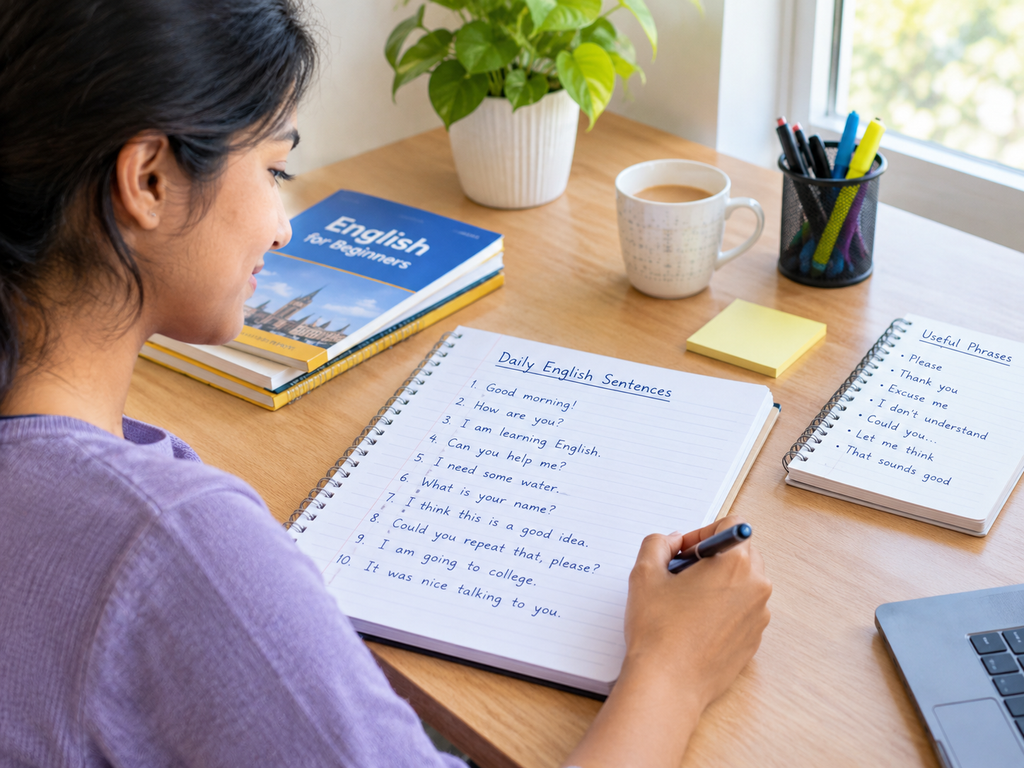
Learn common daily-use sentences
Start with these examples:
| Situation | English sentence | Hindi meaning |
|---|---|---|
| Greeting someone | Good morning! | सुप्रभात! |
| Introducing yourself | My name is Rahul. | मेरा नाम राहुल है। |
| Asking for help | Could you please help me? | क्या आप मेरी मदद कर सकते हैं? |
| Requesting repetition | Could you repeat that, please? | क्या आप इसे दोहरा सकते हैं? |
| Expressing a need | I need some water. | मुझे थोड़ा पानी चाहिए। |
| Talking about your day | I am going to work. | मैं काम पर जा रहा/रही हूँ। |
| Sharing an opinion | I think this is a good idea. | मुझे लगता है कि यह अच्छा विचार है। |
| Expressing uncertainty | I am not sure. | मुझे पक्का नहीं पता। |
| Asking for clarification | What do you mean? | आपका क्या मतलब है? |
| Ending a conversation | It was nice talking to you. | आपसे बात करके अच्छा लगा। |
Practise each sentence aloud. Then change a few words to create new sentences.
For example:
- I need some water.
- I need some help.
- I need more time.
- I need a notebook.
This method helps you learn sentence patterns rather than isolated sentences.
Use simple sentence patterns
Start with these flexible structures:
1. I am + word or phrase
- I am happy.
- I am busy.
- I am ready.
- I am learning English.
2. I have + noun
- I have a book.
- I have a question.
- I have some work.
- I have an idea.
3. I want to + verb
- I want to learn English.
- I want to improve my vocabulary.
- I want to speak confidently.
- I want to ask a question.
4. I like + noun or verb ending in -ing
- I like music.
- I like reading.
- I like learning new words.
- I like talking to my friends.
5. Can you + verb?
- Can you help me?
- Can you explain this?
- Can you speak slowly?
- Can you give me a minute?
Practice activity: Choose one pattern and make five sentences about your own life. Say them aloud without reading after you become familiar with them.
Step 2: Learn Basic English Grammar
You do not need to master advanced grammar before speaking. However, understanding a few basic structures will help you make clear and meaningful sentences.
Learn the basic sentence structure
A simple English sentence often follows this pattern:
Subject + Verb + Object
Examples:
- I read books.
- She likes coffee.
- They play cricket.
- We learn English.
The subject tells us who performs the action. The verb expresses the action or state, and the object receives the action when one is present.
Now compare these sentences:
- Incorrect: I English learn.
- Correct: I learn English.
Practise arranging words in a natural English order.
Understand am, is, and are
These forms of the verb “be” are important for beginners.
| Subject | Correct form | Example |
|---|---|---|
| I | am | I am a student. |
| He | is | He is my friend. |
| She | is | She is happy. |
| It | is | It is easy. |
| You | are | You are helpful. |
| We | are | We are ready. |
| They | are | They are busy. |
Common mistakes include:
- Incorrect: I is happy.
- Correct: I am happy.
- Incorrect: She are my sister.
- Correct: She is my sister.
- Incorrect: They is ready.
- Correct: They are ready.
Say each example aloud and replace the subject with a different person or group.
Learn the three basic tenses
Begin with the present simple, present continuous, and past simple. These structures help you discuss habits, current activities, and completed actions.
| Tense | Example | Use |
|---|---|---|
| Present simple | I work every day. | Habits and routines |
| Present continuous | I am working now. | An activity happening now |
| Past simple | I worked yesterday. | A completed past action |
| Future with will | I will call you tomorrow. | A future action or decision |
Notice how the verb changes to communicate time.
Practise with your own routine:
- I wake up at seven.
- I am studying English now.
- I watched a movie yesterday.
- I will practise again tomorrow.
You do not need to learn every tense at once. Build confidence with these basic patterns before moving to more complex grammar.
Step 3: Build Practical Vocabulary
Vocabulary is an essential part of spoken English, but learning more words is not enough. You must know how to use them in sentences.
Begin with words connected to your daily life.
Learn vocabulary by topic
At home
- Kitchen
- Bedroom
- Cleaning
- Cooking
- Comfortable
Example: “I am cleaning my room.”
At work or college
- Meeting
- Assignment
- Deadline
- Colleague
- Schedule
Example: “I have a meeting at ten.”
Feelings and emotions
- Excited
- Nervous
- Relaxed
- Confident
- Disappointed
Example: “I feel nervous before an interview.”
Useful action words
- Explain
- Suggest
- Improve
- Decide
- Prepare
- Practise
- Remember
- Discuss
Example: “I want to improve my speaking skills.”
Learn words with collocations
A collocation is a combination of words that commonly appear together.
For example:
- Make a decision.
- Take a break.
- Ask a question.
- Give advice.
- Pay attention.
- Make progress.
- Keep practising.
- Gain confidence.
Instead of memorising only “decision,” learn “make a decision.”
Instead of memorising only “attention,” learn “pay attention.”
These combinations make your spoken English sound more natural.
Follow a simple vocabulary routine
Each day:
- Learn five useful words or expressions.
- Write a simple meaning for each.
- Create one personal sentence with each word.
- Say the sentences aloud.
- Review yesterday’s vocabulary before learning new words.
For example, if you learn “confident,” write:
“I feel more confident when I practise English.”
The following day, try using the same word in another sentence.
Remember: Five words that you can confidently use in conversation are more valuable than a long list of words you quickly forget.
Step 4: Practise Listening and Pronunciation
Speaking and listening support each other. When you listen to clear English conversations, you become more familiar with common expressions, sentence rhythm, and pronunciation.
You can use beginner-level English videos, short dialogues, educational podcasts, or learning resources designed for elementary learners.
The British Council offers A1 speaking practice with videos and useful everyday phrases. Its A1 listening lessons also provide practice for familiar situations such as shopping and workplace communication.
Try the listen-and-repeat method
Follow these steps:
- Choose a short English audio or video clip.
- Listen to one sentence carefully.
- Pause the audio.
- Repeat the sentence aloud.
- Listen again and notice the words you missed.
- Repeat until the sentence feels more comfortable.
For example, practise:
“Could you please tell me the time?”
Pay attention to the full sentence rather than pronouncing each word separately.
Focus on clarity, not accent
You do not need to sound British or American to speak English well. Your first goal should be understandable pronunciation.
Practise these common sound contrasts:
- Ship and sheep.
- Live and leave.
- Sit and seat.
- Bad and bed.
Say each pair slowly and listen for the vowel difference. A dictionary with audio pronunciation can help you check individual words.
Also pay attention to word stress. In many English words, one syllable is more prominent than the others. Listening to examples and repeating them can help you develop a more natural rhythm.
Record your voice
Choose a familiar topic, such as your daily routine, and record yourself speaking for one minute.
Listen to the recording and ask:
- Are my sentences understandable?
- Do I pause too often?
- Which words are difficult to pronounce?
- Do I repeat the same words frequently?
- Is my message clear?
Do not criticise every small mistake. Choose one area to improve and record yourself again later.
Step 5: Speak English Every Day
Reading grammar explanations can help you understand English, but speaking requires actual speaking practice.
You do not need to find a perfect speaking partner before you begin. You can start alone and gradually include other people.

Use self-talk
Self-talk means describing your actions, thoughts, or surroundings in English.
While getting ready in the morning, say:
- I am brushing my teeth.
- I am getting ready for work.
- I need to pack my bag.
- I am checking my schedule.
- I am leaving home now.
When you return home, describe your day:
“Today was a busy day. I went to work in the morning. I attended a meeting and finished my tasks. In the evening, I came home and practised English.”
You can make your sentences longer as your vocabulary improves.
Try mirror speaking
Stand in front of a mirror and speak about a familiar topic for one or two minutes.
Start with simple topics:
- My family
- My best friend
- My daily routine
- My favourite food
- My hometown
- My future goals
For example:
“My name is Priya. I live in Delhi. I am learning English because I want to communicate more confidently. In my free time, I enjoy reading and listening to music. My goal is to speak English more comfortably at work.”
The goal is to express your thoughts without stopping after every sentence to check grammar.
Find a speaking partner
Practise with a friend, classmate, colleague, teacher, or language-learning group.
Set a simple rule: speak in English for five minutes about an everyday topic.
If you cannot remember a word, explain the meaning using words you already know.
For example, if you forget the word “umbrella,” you could say, “It is something we use when it rains.”
This strategy helps you continue a conversation instead of giving up when a word is missing.

Step 6: Learn Through Real-Life Conversations
Real-life dialogues help you understand how English is used in different situations.
Read the conversations below aloud. First practise one person’s lines, then switch roles and practise the other person’s lines.
Conversation 1: Introducing yourself
A: Hi! My name is Ankit. What’s your name?
B: Hello! I’m Neha. Nice to meet you.
A: Nice to meet you too. Are you a student?
B: Yes, I am. I am studying commerce. What about you?
A: I work in a private company.
B: That’s nice. What do you do there?
A: I work in the customer service department.
Useful expressions:
- What’s your name?
- Nice to meet you.
- What about you?
- What do you do?
Practise changing the names, occupations, and interests to make the conversation your own.
Conversation 2: At a shop
Customer: Excuse me, how much is this shirt?
Shopkeeper: It is ₹800.
Customer: Do you have it in a different size?
Shopkeeper: Yes, we have medium and large.
Customer: Could I try the medium size, please?
Shopkeeper: Certainly. The changing room is over there.
Customer: Thank you.
Useful expressions:
- Excuse me.
- How much is this?
- Do you have…?
- Could I try…?
- Certainly.
These expressions are useful for shopping, travelling, and other everyday situations.
Conversation 3: Asking for help at work or college
A: Hi, could you help me with this assignment?
B: Sure. Which part are you finding difficult?
A: I don’t understand the second question.
B: Let me have a look. I think you need to explain your answer with an example.
A: Oh, I see. Thank you for explaining it.
B: You’re welcome.
Useful expressions:
- Could you help me?
- Which part…?
- I don’t understand.
- Let me have a look.
- Thank you for explaining.
Conversation 4: Talking about your day
A: How was your day?
B: It was good, but quite busy.
A: What did you do?
B: I attended two meetings and completed a report.
A: That sounds productive. What are you doing this evening?
B: I am going to relax and practise English for a while.
Useful expressions:
- How was your day?
- It was quite busy.
- That sounds good.
- What are you doing this evening?
Conversation 5: When you do not understand someone
A: Could you send me the file before noon?
B: Sorry, could you repeat that, please?
A: Please send me the file before twelve o’clock.
B: Sure. Do you mean the final version?
A: Yes, that’s right.
B: No problem. I’ll send it before noon.
Useful expressions:
- Could you repeat that, please?
- Could you speak a little more slowly?
- What does that mean?
- Do you mean…?
- Let me make sure I understand.
Learning these expressions is important because good communication involves asking questions and checking understanding, not simply speaking without pauses.
Step 7: Think in English
Many learners first create a sentence in their native language and then translate it into English. This can make speaking slow and tiring.
You do not need to stop translating completely on your first day. Instead, gradually connect familiar situations directly with simple English sentences.
Begin with your surroundings
Look around your room and describe what you see.
- This is my desk.
- My phone is on the table.
- The window is open.
- I have a notebook.
- My room is clean.
Next, describe your activities:
- I am making tea.
- I am reading a message.
- I am waiting for my friend.
- I am going to the market.
Keep the sentences simple. You are training yourself to express familiar ideas without searching for complicated language.
Ask yourself simple questions
During the day, ask yourself:
- What am I doing?
- What do I need to do next?
- What did I learn today?
- What do I like about this place?
- What am I planning for tomorrow?
Answer each question in one or two sentences.
For example:
Question: What did I learn today?
Answer: I learned five new English expressions. I also practised a short conversation.
As you become more comfortable, add reasons and details.
“I learned five new English expressions because I want to communicate more clearly at work.”
Step 8: Improve Your Confidence
Confidence is an important part of spoken English, but it does not mean speaking without making mistakes.
A confident learner is willing to communicate, ask questions, learn from corrections, and try again.
Stop waiting for perfect English
If you wait until your grammar, vocabulary, and pronunciation are perfect, you may postpone speaking for too long.
Begin with what you know.
Instead of trying to deliver a complicated explanation, say:
“I think this is a good idea because it saves time.”
This simple sentence communicates an opinion and gives a reason.
You can add more detail as your ability grows.
Learn useful phrases for difficult moments
Sometimes, you may need time to think. These expressions can help:
- Let me think for a moment.
- That’s an interesting question.
- I am trying to explain my point.
- I am not sure, but I think…
- Could you please explain that again?
- What I mean is…
For example, during an interview, you could say:
“That’s an interesting question. Let me think for a moment. I believe teamwork is important because it helps people share ideas and solve problems.”
You do not need to rush every answer.
Treat mistakes as feedback
Suppose you say, “He go to office every day.”
The corrected sentence is, “He goes to the office every day.”
Understand the correction, repeat the right sentence, and use it in another example.
“He goes to college every day.”
Do not let one mistake prevent you from continuing the conversation.
Step 9: Use a Daily English-Speaking Routine
A practical routine makes it easier to practise consistently. Start with 30 minutes a day if that fits your schedule. If you have less time, begin with ten minutes and build gradually.
A 30-minute daily practice schedule
| Time | Activity | What to do |
|---|---|---|
| 5 minutes | Vocabulary | Review five useful words or phrases. |
| 5 minutes | Listening | Listen to a short beginner-level English clip. |
| 5 minutes | Repetition | Repeat useful sentences aloud. |
| 10 minutes | Speaking | Describe your day or practise a dialogue. |
| 5 minutes | Review | Note mistakes and choose one improvement goal. |
Use a notebook to record new expressions, sentences you found difficult, and topics you want to practise again.
Choose a topic for each day
Use these everyday speaking topics to avoid running out of ideas:
- Monday: Introduce yourself.
- Tuesday: Describe your family.
- Wednesday: Talk about your daily routine.
- Thursday: Describe your favourite food.
- Friday: Talk about your work or studies.
- Saturday: Describe your hometown.
- Sunday: Talk about your weekly experience.
Speak for one minute at first. Later, try two or three minutes.
If you are a teacher or a learner working with a partner, ask follow-up questions. For example, if the topic is favourite food, ask why the person likes it, when they usually eat it, and how it is prepared.
Step 10: Track Your Progress
Improvement becomes easier to notice when you keep a simple record of your practice.
Do not measure progress only by how many words you know. Also notice how comfortably you can use those words.
Use a weekly progress checklist
At the end of each week, check the skills you practised:
- I introduced myself in English.
- I spoke about my daily routine.
- I learned and used new expressions.
- I practised listening to English.
- I completed at least one short conversation.
- I recorded myself speaking.
- I reviewed my common mistakes.
You do not need a perfect score. Use the checklist to identify the next skill to practise.
Compare your recordings
Record yourself speaking about the same topic at the beginning and end of a week.
For example, describe your daily routine on Monday and record it again on Sunday.
Compare the recordings for:
- Sentence clarity.
- Ability to continue without long pauses.
- Use of vocabulary.
- Pronunciation of familiar words.
- Confidence while expressing ideas.
You may notice improvement in some areas before others. That is normal. Continue practising the skills that need more attention.
Common Spoken English Mistakes Beginners Should Avoid
Small mistakes are part of learning, but recognising frequent errors helps you improve faster.
| Common mistake | Better sentence | Explanation |
|---|---|---|
| Myself Rahul. | My name is Rahul. / I’m Rahul. | Use a natural introduction. |
| I am agree. | I agree. | “Agree” is a verb. |
| He go to work. | He goes to work. | Add -s or -es with he, she, and it in the present simple. |
| She don’t know. | She doesn’t know. | Use “doesn’t” with he, she, and it. |
| I didn’t went. | I didn’t go. | Use the base form after “didn’t.” |
| Discuss about the problem. | Discuss the problem. | “Discuss” takes a direct object in this structure. |
| I have 20 years old. | I am 20 years old. | Use “am” to express age. |
| He is more taller. | He is taller. | Do not combine “more” with the -er form. |
Avoid these learning habits
1. Memorising grammar without speaking
Understanding a rule is useful, but you also need to practise using it in conversation.
2. Learning too many words at once
Learn manageable amounts and review them regularly.
3. Translating every sentence
Start using familiar English phrases directly in everyday situations.
4. Speaking too quickly
Speak at a comfortable pace. Clear communication is more important than speed.
5. Comparing yourself with fluent speakers
Everyone begins at a different level. Compare your current ability with your own earlier performance.
6. Being afraid of corrections
A useful correction shows you how to improve. Repeat it and practise using it again.
A 30-Day Spoken English Practice Plan
Use this beginner-friendly plan to organise your first month of practice. The schedule is a guide, not a guarantee of fluency within 30 days.
Week 1: Build your foundation
Focus on basic sentences, greetings, introductions, and familiar vocabulary.
- Day 1: Introduce yourself in five sentences.
- Day 2: Practise greetings and polite expressions.
- Day 3: Learn am, is, and are.
- Day 4: Describe your family.
- Day 5: Talk about your daily routine.
- Day 6: Learn ten useful action words.
- Day 7: Review the week’s sentences and record a one-minute introduction.
Week 2: Develop sentence-building skills
Focus on basic grammar, questions, and everyday conversations.
- Day 8: Practise present simple sentences.
- Day 9: Ask and answer five basic questions.
- Day 10: Describe what you are doing now.
- Day 11: Talk about your hobbies.
- Day 12: Practise a shopping conversation.
- Day 13: Learn polite requests.
- Day 14: Record yourself speaking about your day.
Week 3: Improve listening and speaking
Focus on understanding spoken English and responding naturally.
- Day 15: Listen to a short English dialogue.
- Day 16: Repeat ten useful phrases.
- Day 17: Practise asking for clarification.
- Day 18: Speak about your hometown.
- Day 19: Have a five-minute English conversation.
- Day 20: Record yourself and review your pronunciation.
- Day 21: Retell a simple story in your own words.
Week 4: Build confidence
Focus on longer answers, expressing opinions, and real-life practice.
- Day 22: Talk about your future goals.
- Day 23: Explain your favourite hobby.
- Day 24: Practise answering interview questions.
- Day 25: Speak about a memorable experience.
- Day 26: Give your opinion on a familiar topic.
- Day 27: Complete a ten-minute conversation.
- Day 28: Review your most common grammar mistakes.
- Day 29: Record a two-minute talk on a topic of your choice.
- Day 30: Compare your recordings and plan your next month.
At the end of the month, identify the areas in which you feel more comfortable and those that still need practice. Continue with slightly more challenging conversations, new vocabulary, and longer speaking activities.
Frequently Asked Questions About Spoken English for Beginners
1. How can I learn spoken English from scratch?
Start with greetings, introductions, everyday sentences, and basic grammar. Practise listening and speaking daily, learn useful expressions in context, and gradually move towards short conversations. You can begin at home without waiting for advanced vocabulary.
2. Can I improve my spoken English at home?
Yes. You can practise self-talk, mirror speaking, listening and repetition, voice recordings, and role-play conversations at home. A speaking partner or teacher can provide additional feedback when available.
3. How much time should beginners practise English every day?
Start with 10–30 minutes, depending on your schedule. A short routine that you can maintain consistently is a practical starting point. Adjust your practice time as your confidence and learning needs change.
4. Should I learn grammar before speaking English?
Learn basic grammar alongside speaking practice. You do not need to master every grammar rule first. Start speaking with simple, useful sentences and correct important mistakes as you learn.
5. How can I speak English without translating from Hindi?
Begin by connecting familiar activities directly with simple English sentences. Describe your surroundings, talk about your routine, and practise common expressions. Translation may still help occasionally, but try to use familiar phrases directly when possible.
6. How can I improve my English pronunciation?
Listen to clear examples, repeat short sentences, and pay attention to individual sounds, word stress, and sentence rhythm. Record your voice and compare it with reliable pronunciation examples. Focus on clarity rather than copying a particular accent.
7. What should I do if I feel nervous while speaking English?
Start with short conversations about familiar subjects. Practise alone, then with a trusted friend or speaking partner. Allow yourself time to think, ask people to repeat information when necessary, and treat mistakes as opportunities to learn.
8. Which resources can help beginners practise spoken English?
The British Council’s LearnEnglish website provides level-based speaking and listening activities. Cambridge English also offers speaking activities for learners, including beginner-level practice. Choose resources that match your current level and practise using the language aloud.
Conclusion: Start Speaking English One Sentence at a Time
Learning spoken English for beginners does not require perfect grammar, a large vocabulary, or an expensive learning setup. It requires a practical plan, useful learning materials, and regular opportunities to speak.
Start with everyday sentences. Build your vocabulary around familiar topics. Learn basic grammar, listen to clear English, practise real-life conversations, and review your progress each week.
Most importantly, do not wait until you feel completely ready. Begin with one sentence, then a short conversation, and gradually work towards expressing your thoughts more comfortably.
Your next step: Choose one topic today, such as your daily routine, and speak about it in English for one minute. Repeat the activity tomorrow and notice what becomes easier.
For more guidance, explore Fluent Personality for resources on spoken English, vocabulary, pronunciation, communication skills, confidence, and public speaking. Make English practice part of your daily routine, and keep moving forward one conversation at a time.
CONNECT WITH US